
Delaware County Court Records After Arrest
The local court path starts with an arrest, central intake, and booking. Delaware County's official criminal-justice flow says a person may be confined because of alleged probable cause, an arrest warrant, a bench warrant, a probation or parole allegation, or contempt. For new criminal charges, arraignment follows within 72 hours before a magistrate. That first court step matters because bail can be approved or denied, conditions can be set, and a monetary bail opportunity can be given if the court allows it.
The court record is not the same thing as the jail booking record. Jail data helps show whether someone is in George W. Hill Correctional Facility, while the docket shows the case filed in court. Formal charges can change after review by the Delaware County District Attorney's Office, so a booking entry may not match the final charge list. Use Delaware County jail inmate records for custody and Delaware County jail mugshots for booking-photo limits, then use the court docket to follow the prosecution.
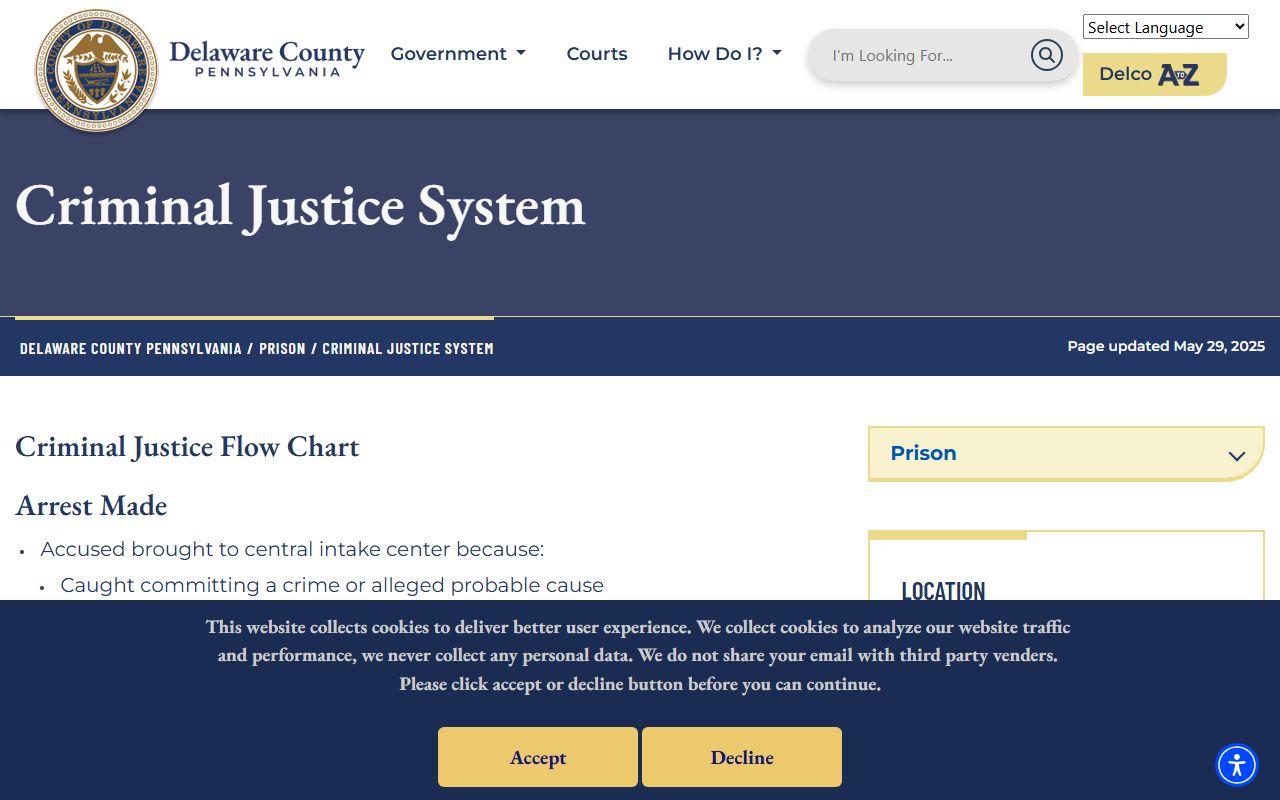
The county's official criminal-justice flow is shown on the Delaware County criminal justice system page. The screenshot below is useful because it places jail custody, arraignment, preliminary hearing, formal arraignment, pretrial conference, trial, sentencing, and appeal in one local sequence.
Find Court Records After Arrest
The practical search starts with the Pennsylvania UJS Case Search, the statewide public docket portal. Delaware County also points users through its public access page and the Office of Judicial Support criminal dockets page. OJS says the Criminal Division handles criminal case files processed from local district justices, bail posting and return, summary appeals, and appeals to appellate courts. For Common Pleas criminal cases, the county's forms page gives the CP-23-CR number pattern.
- Open UJS Case Search and choose a search path such as Participant Name, Docket Number, OTN, Complaint Number, or Date Filed.
- Filter by Delaware County or Judicial District Delaware - 32 when the portal offers that field.
- Open the docket sheet and compare the defendant name, filing date, OTN, complaint number, and charge list.
- Read each event entry in date order because bail, hearings, continuances, dispositions, and sentencing may appear on separate lines.
- If a recent arrest is missing, check again later and verify custody through VINELink or George W. Hill Records.
UJS warns that recent entries may not appear at once and that docket sheets do not replace a Pennsylvania State Police criminal-history background check. The portal also requires current browser support, JavaScript, cookies, TLS 1.2 or higher, and pop-ups for some reports.
| Search field | Best use | Delaware County note |
|---|---|---|
| Participant Name | Defendant name search | Useful when only the person's name is known. |
| Docket Number | Known court case | Common Pleas criminal cases use CP-23-CR-####-yyyy. |
| OTN | Links arrest paperwork to court filing | Often the cleanest bridge from booking to docket. |
| Complaint Number | Police or magisterial paperwork | Helpful for recent arrests. |
| County or Judicial District | Limits statewide results | Choose Delaware or Delaware - 32. |
Delaware County Charging Records
A court docket may begin with a complaint and then move through later filings. Delaware County's flow page says a preliminary hearing is usually scheduled within 3 to 10 days, though it can be postponed. The magistrate decides whether enough evidence supports holding the charges for trial. After that step, formal arraignment often occurs about 30 days after the final preliminary hearing. A person in custody generally appears by video from the prison.
| Document | What it does | Where it fits |
|---|---|---|
| Criminal complaint | Sets out alleged offenses and basic facts. | Early arrest and magisterial district court stage. |
| Information | Prosecutor's formal list of charges after review. | Common Pleas stage after charges are held for court. |
| Indictment | Formal charging document used in some criminal systems. | Less common for ordinary Pennsylvania county docket searches. |
For Delaware County users, the key point is that the filed charge record can be narrower, broader, or different from what family members heard at booking. Charges may be reduced, dismissed, held for trial, amended, or resolved by plea or trial. The District Attorney's Office prosecutes criminal cases, while OJS maintains the court case file and docket access.
Charge Status After Arrest
Each charge has a stage. A pending charge is an accusation, not a conviction. A dismissed charge means the court did not keep that count active. A reduced charge means the case moved forward on a lesser offense or grade. A nolle prosequi entry means the prosecutor declined to continue that charge. Delaware County court records after a jail arrest should be read with those terms in mind because one docket can include many counts at different stages.
| Status | Plain meaning | Record caution |
|---|---|---|
| Pending | The charge has not been finally resolved. | Do not treat it as guilt. |
| Held for court | A preliminary hearing found enough basis to proceed. | The prosecution still must prove the case. |
| Reduced or amended | The charge or grading changed. | Compare older and newer docket lines. |
| Dismissed | The charge did not continue. | Other counts in the case may remain. |
| Nolle prossed | The prosecutor did not pursue that count. | Look for the final disposition on all counts. |
Bail Records After Arrest
Bail is set by the court, but the jail checks whether release can actually occur. Delaware County's bail and release page says physical after-hours bail can be accepted at George W. Hill between 8:00 p.m. and 8:00 a.m. if there are no outstanding issues. The person posting should contact Records Director Michael Root during business hours with the incarcerated person's name, date of birth, intent to post, and scheduled arrival time. Physical after-hours posting requires cash and identification.
Online bail may be available through PAePay Bail. That is not the same as commissary money. A detainer, warrant, no-bail order, probation issue, or other hold can block release even after one bail amount is paid. The docket is the place to read the bail order; the jail records unit is the place to check whether a release is blocked by another issue.
| Bail issue | What to check | Where to verify |
|---|---|---|
| Cash or monetary bail | Amount and conditions | UJS docket, bail order, George W. Hill Records. |
| Online payment | Case eligibility | PAePay Bail and the court docket. |
| Nonmonetary conditions | Release terms | Docket sheet and court order. |
| Hold or detainer | Outstanding issue that blocks release | Jail records and the issuing court or agency. |
Warrants and Court Holds
The Delaware County Sheriff's Office has a Bench Warrant Division, but the official sources inspected did not show a countywide active-warrant search database. The local path is to contact the Sheriff's Main Office, search UJS docket events, and confirm any warrant with the issuing court or an attorney. If a person has already been arrested on a bench warrant or contempt order, the county criminal-justice flow says a hearing occurs within 72 hours.
The Bench Warrant Division page and Sheriff's telephone directory place sheriff warrant work at the courthouse in Media. City of Chester has official CRIMEWATCH and mobile-app material for alerts, anonymous tips, and most-wanted posts, but those tools are not a county jail roster and are not complete legal warrant verification.
Charges and Convictions
Public court records after an arrest often show accusations long before a final outcome. That distinction is important for anyone reading a Delaware County docket. A charge is the government's allegation. A conviction is the result of a guilty plea, verdict, or other qualifying final disposition. Court records may also show dismissed charges, ARD discussions for some minor offenses, bail actions, continuances, and sentence entries.
| Question | Charge | Conviction |
|---|---|---|
| Meaning | An accusation filed in court. | A final finding or plea. |
| Stage | Can appear soon after arrest. | Appears after case resolution. |
| Proof level | Probable cause may be enough early on. | Requires plea, verdict, or lawful adjudication. |
| Reader caution | May be changed or dismissed. | Still check appeal, sentence, and expungement history. |
Sealed and Expunged Records
Pennsylvania law makes many court records public, but access is not unlimited. The Pennsylvania Right-to-Know Law frames public-record requests, while criminal-history dissemination is also shaped by 18 Pa.C.S. Section 9121. Expungement questions connect to 18 Pa.C.S. Section 9122. Juvenile matters, sealed records, limited-access cases, investigative material, safety-sensitive information, and expunged records may not appear in a public search.
| Record state | What it means | Public search effect |
|---|---|---|
| Limited access | Public view is restricted by rule or order. | The case may not appear or may show less detail. |
| Sealed | Hidden from normal public access. | Verify through the court, not a search engine. |
| Expunged | Criminal-history record is removed under law. | Old copies outside government systems may still need separate action. |
Important: Docket searches are not FCRA consumer reports and should not be used for employment, housing, credit, or insurance screening.